Mycelial building
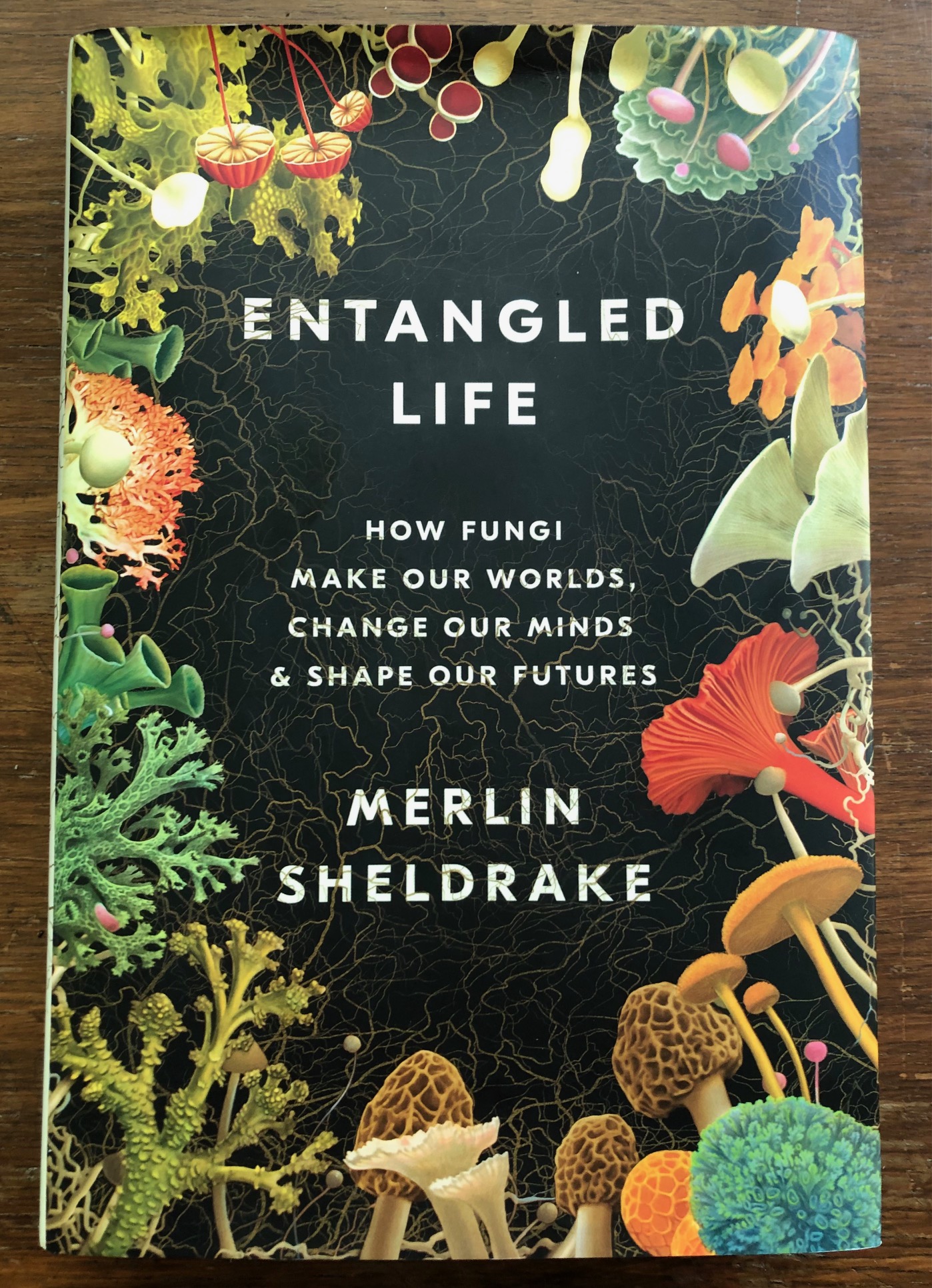
Reading Merlin Sheldrake’s 2020 book Entangled Life, on the world of fungi may change how you look at your back yard and your dinner, what you think of as “living” and not-living. It will stretch your thinking about interconnectedness and communication. It certainly has for me. Search for it in a library near you at worldcat.org.
Fungi and its mycelium, the root-like structure of a fungus, are experts at eating and digesting – decomposing – almost any substance, including what humans consider waste material, everything from agricultural waste to cigarette butts to radioactive debris to plastics. Sheldrake explains that fungi can also be trained to develop the ability to digest new-to-them material.
The study of fungi and fungi’s fruiting bodies, i.e. mushrooms, is relatively new as a discrete academic field. People like Paul Stamets (for fans of Star Trek, it was Stamets who advised the Discovery series writers on the possibility of a mycelial network, operated in the series by engineer Paul Stamets; you can read about Stamets’ work to restore bee colonies using fungi here ), Peter McCoy (founder of the grassroots Radical Mycology and the school and research hub Mycologos), and Sheldrake are expanding popular awareness of the undiscovered potential of fungi and encouraging a growing body of citizen-scientists who are adding to our understanding of the amazing range and abilities of fungi.

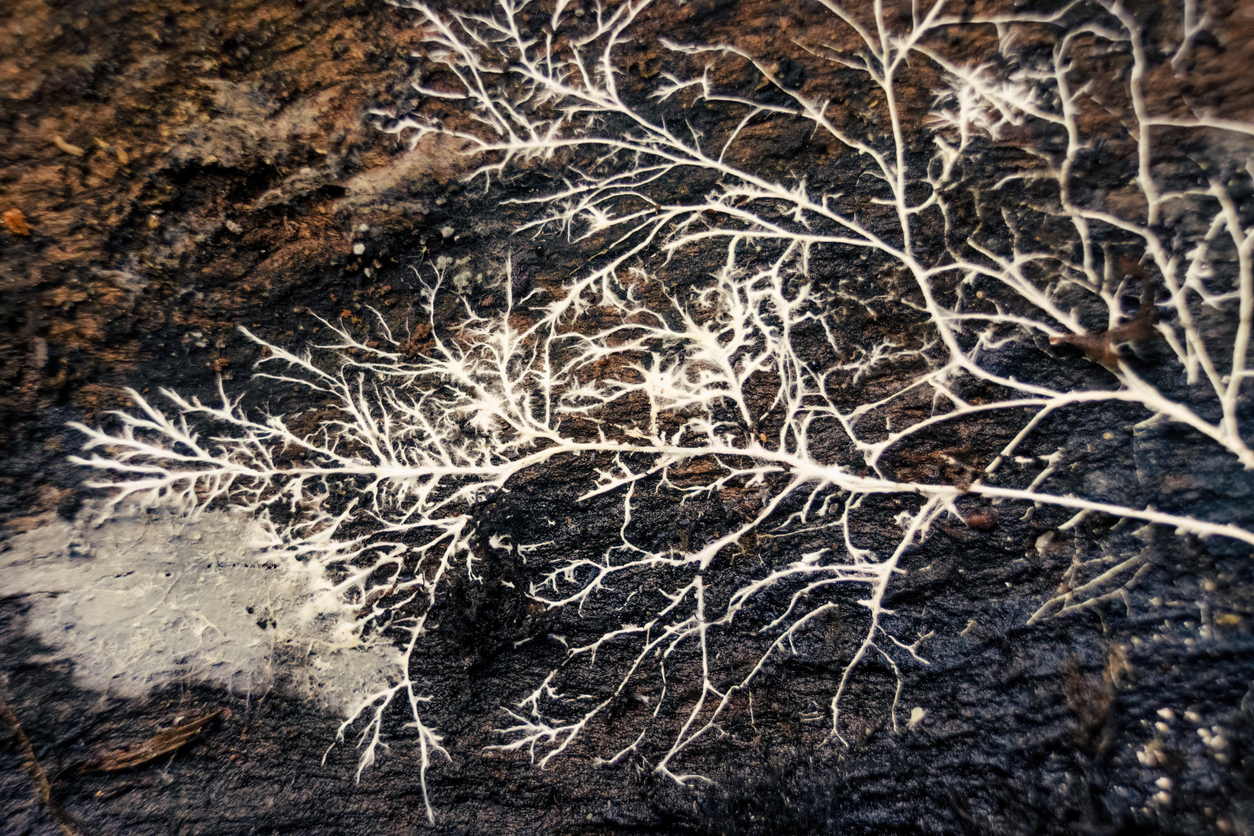
Above, left: Mycelium fungus, Fusarium euwallaceae, Alexey Protasov (iStock)
Above, right: Macro photography of a white fungus root, Mauricio Acosta (iStock)
In construction, design
That expanding awareness includes applications in construction and design. Below is a selection of companies and entities that are working to investigate, make, and use construction materials based on fungal mycelium and the many unique characteristics of mycelium. (with a hat tip to perplexity.ai for some of the firm names).
Makers
Symbiocene Living – a PLP/Labs project of London-based PLP Architecture; linked page has a short video about their work with mycelium
Ecovative – based in New York State, Ecovative’s entire product line – food (MyBacon), fashion & textiles, packaging, and construction material – is based on mycelium, the root structure of fungi
Amhuru – Alaska-based, growing “Mycelial Foods and Textiles”; the blog has nice visuals
MycoTile – Kenya-based company producing building materials using “readily available agricultural waste and rapidly growing mushroom mycelium as a bonding agent.” See related article Finding Sustainable Alternatives to Traditional Building Materials (2025; Technology Networks Diagnostics)
Biohm – London-based firm “exists to systemically and holistically address the CORE DRIVERS of humanity’s maladaptation to the earth system.” From their Mycelium Tech page: “Biohm’s mycelium technology enables product properties that are unprecedented in academia and industries such as construction, automotive, fashion, textile, electronics, energy, agriculture, aerospace, health, and many more.”
Myconom – Istanbul-based, produces packaging and acoustic tiles made from mycelium, does custom design and product development. “Mycelium acts as a natural binder, forming durable, cohesive materials without the need for synthetic adhesives. This unique characteristic enables us to create products that are entirely free from petrochemical or toxic binders, supporting both environmental health and material integrity.’ See their recent post Mycelium Breaks Down Plastic
Mykor – Produces building insulation, based in UK and Portugal – “We use biomass residues from industries that would have been incinerated or discarded into landfill, transforming them with our biotechnologies and specially engineered mycelium strains into foam composites.”
COMU Labs Inc. – Furniture, Interiors, Pre-Fab Housing – “Bridging the gap between sustainability and affordability with MycoWood”, short video of how it’s made
MOGU – Italian firm produces acoustic tile, wall panels, and resilient floors, “founded on the belief that it is possible to employ Nature’s intelligence to design responsible, functional and beautiful products for our everyday environments.”
MycoHAB – “MycoHAB is a non-profit foundation focusing on the research and development of mycelium-based structures to create a new generation of building materials to benefit communities within Africa and abroad. … MycoHAB Namibia is the commercial subsidiary of MycoHAB in Mauritius…” “In Namibia, MycoHab built the world’s first self supported mycelium structure. The building converted 13 tons of environmentally damaging encroacher bush into 4 tons of gourmet mushrooms and 1000 carbon storing mycoblocks that built the demonstration structure.”
Projects
The Phoenix (2023) – Affordable modular housing in West Oakland, CA – MBH Architects, Ecovative grew the core of prefabricated facade panels using agricultural byproducts and mycelium, Kreysler & Associates developed a fiber-reinforced polymer shell for the facade panels.
Olive Tree Waste and Biocomposites for Ford’s Car Parts (2024; Designboom) – Using olive tree waste blended with biocomposites, Ford was able to create car parts that “can help reduce the plastic used in such components and contribute to cleaner air in the local area by avoiding burning as a means of waste disposal. Engineers produced prototype footrests and parts of the boot area using olive tree waste. Ford mentions that during the testing phase, the engineers were able to manufacture car parts that were both robust and durable.” The link includes a 1:41 min video clip on the process.
Homegrown Wonderland (2024; DesignBoom) – Whimsical temporary pavilion in New York Botanical Garden designed by Andrew Kong Studio, engineered by ARUP is made with mycelium bricks. When the exhibit is over, “the bricks will be composted, and the timber will be reused.”
Mycotecture Off Planet (2021; NASA) – Phase II report on the U.S. National Aeronautics and Space Administration investigation into light-weight habitats for space exploration. “During Phase 1, we identified a novel biology-based solution to in situ production of usable components for space exploration: using fungal mycelial composites to grow structures off-planet, from habitats to furniture.” The focus was on Mars. Phase II continues this work, but with a focus on the Moon. See more on Phase III here (2024).
MoMA PS1 gallery pavilion (2014; dezeen) – A cluster of circular towers “Designed by The Living principal David Benjamin, the structure is built from entirely from biodegradable materials. Each of the bricks used to construct it were grown rather than manufactured, using a combination of agricultural byproducts and mushroom mycelium – a kind of natural digestive glue. Specially designed moulds were used to cultivate the bio-bricks. These were coated in a light-refracting film developed by materials firm 3M and some were then built into the structure around the top, helping to bounce light down inside.
Further sources
MycoStories – “Supporting pioneers harnessing the power of Fungi to address the most pressing issues of our time.” – See the latest industry news; go to their ecosystem page for maps of the fungi industry, investors, and research institutions
Mycology for Architecture (MycoTecture) – UK-based, “An international collaboration for designers working with fungi as a biomaterial” they offer workshops, talks, and a page of projects from their presenters
Fungal Mycelium Offers Sustainable Alternative to Concrete (2025; AZOBuild) – “In a new study, scientists have developed a living building material using fungal mycelium that can mineralize itself or be mineralized by bacteria, offering a potentially self-healing, sustainable alternative to concrete.“
An Emerging Sustainable Construction Material – Mycelium Bricks (undated, Happho)- step-by-step of the process of making mycelium brick, includes fascinating close up photos of the hair-like mycelium forming the structure
Building with Mushrooms (2018, Critical Concrete) – “In our latest research we have been focusing on the insulation properties of fungal mycelium and developing different kinds of prototypes to be tested and compared.”
Scientists build ‘self-repairing’ bricks out of fungus as a sustainable alternative to concrete (2025; GoodGoodGood) – Montana State University scientists biomineralizing mycelium to create “concrete-like”living” bricks. “Through a process called biomineralization, the calcium carbonate causes the mycelium to harden into bonelike structures called “scaffolds.”
10 Start-ups Creating Innovative and Sustainable Building Materials, from Mycelium Bricks to Water Purifying Tiles (2022; ArchDaily) – an overview of approaches, including mycelium bricks, to reducing construction’s carbon footprint. “One of the most prominent fields of research is concerned with biofacture, the type of process that involves using biological organisms to manufacture materials. By understanding the abilities of organisms such as algae of fungi, alternatives to widely used materials can become carbon neutral or even carbon negative. Other initiatives are researching novel ways to use untapped, yet readily available resources such as desert sand, soil, or waste from demolitions.”
Finally, go to Sheldrake’s website to see him in action. He’s very good at giving clear explanations. Be sure to check out his book being eaten by fungi and hear music incorporating the sounds of fungi.
Below is a screenshot from the Video page of Merlin Sheldrake’s website, showing the book being decomposed by oyster mushrooms.

More…
The word “fungi” can be pronounced in different ways.
The late avant guard composer John Cage was also a mycologist. See here and here and this clip of Cage discussing a mushroom haiku.
A couple of general mushroom sites: Mushroom World has a mushroom database, lots on identification, and a Useful Links section. Mushroom Appreciation also has quite a bit on identification, with a focus on North America, and on edible mushrooms.
Please feel free to share any interesting makers or projects using fungal mycelium, or good links to anything to do with mushrooms.